Perspective
What Keeps a Corporate Website Standing in the Age of AI
AI makes websites cheaper to build and easier to break. The companies that last treat security, systems and operations as part of the product.
AI has made a website cheap to produce. That is not the same as making it cheap to own.
None of this is an argument against AI. It lets a good idea become a working product faster, and it gives a three-person team output that used to require thirty. The problem is that generating more is not the same as owning more.
A homepage that might once have taken a team two months can now be generated in ten minutes. Responsive layout, white space, motion, copy. It looks plausible. For a company with a limited budget, it is tempting to ship it and move on.
Then the site goes live.
It starts receiving inquiries. It starts showing up in search. It starts appearing on a buyer's shortlist. From that point, it is no longer a design artifact. It is a service that has to keep running. The server needs patches. The content needs updates. Someone has to answer the form. The backup has to restore. If any one of those fails, the money saved at the start comes back as a different kind of bill.
This is the question I want to work through: what does a corporate website actually need in order to last in the age of AI?
The next hole arrives faster
In July 2026, security researchers disclosed a two-bug chain in WordPress core called wp2shell. CVE-2026-63030 was a batch-route confusion in the REST API. CVE-2026-60137 was an SQL injection in WP_Query's author__not_in parameter. Chained together, an anonymous request could reach remote code execution.
The affected range was WordPress 6.9.0 through 6.9.4 and 7.0.0 through 7.0.1. The 6.8 branch carried only the SQL injection, fixed in 6.8.6. The full RCE chain was fixed in 6.9.5 and 7.0.2. The detail that matters is not the version list. It is the location: core. No plugin, no unusual setting, no custom configuration. A default install was in range.
The speed matters too. Public exploit code appeared within hours of the patch. Weaponized attempts followed in less than two days. WordPress pushed forced updates, but updates take time to reach every site. Attackers do not wait for the rollout to finish.
Three months later, PHP had its own moment. php2shell covers CVE-2026-109618 and CVE-2026-109619, two memory-safety flaws in the PHP engine's handling of out-of-memory conditions and session.upload_progress. A crafted request can leave stale request memory behind. A later request can read it, leak process memory and, in some configurations, execute code. Wiz's summary is blunt: almost every PHP release of the last decade is affected by at least one of them, going back to 5.4. The fixed versions are 8.2.35, 8.3.36, 8.4.27 and 8.5.12.
The timeline was tighter. Exploitation attempts were recorded in honeypots four days before the patch. After public disclosure on October 21, scanners and proof-of-concept code spread within hours. On October 26, CISA added both vulnerabilities to its Known Exploited Vulnerabilities catalog.
One honest caveat: php2shell is not a one-request exploit that works everywhere. It depends on memory layout, worker reuse and server configuration. Wiz said it had not observed a reliable, general end-to-end exploit in its telemetry. But attackers do not need every target to fall. They need volume. They keep trying until they find the site that missed the patch and happens to fit the chain.
Both stories share a backdrop: vulnerability research is becoming a capability you can buy with compute.
Searchlight Cyber's write-up says wp2shell was found with GPT-5.6 Sol Ultra, at a compute cost of roughly $25 and about ten hours of work. Wiz says frontier models were what made the decades-old PHP flaws practical to exploit, not just possible to describe.
That is the shift. AI makes it faster to write code, so new features, plugins and integrations arrive faster. AI also makes it faster to find flaws, so old code gets interrogated faster. Put those two curves together and the patch window gets shorter.
The first principle of security architecture, then, is subtraction.
Pages that can be static should not run through PHP. Endpoints that must be dynamic should be deployed, rate-limited and authorized separately, not share an execution path with the content admin. Plugins are not a collection to maximize. Every one adds a vendor, a release note and a door that someone may forget. Database accounts get only the permissions they need. Admin accounts get second factors. FTP gets retired.
Patches need a rhythm, too. Critical core and runtime issues should run on an hourly clock, not a quarterly one. If a fix cannot be applied immediately, take the surface offline or put an edge rule in front of it, then schedule the real work. The dangerous part is not the public advisory. It is the silence inside a company that cannot say which version it is running.
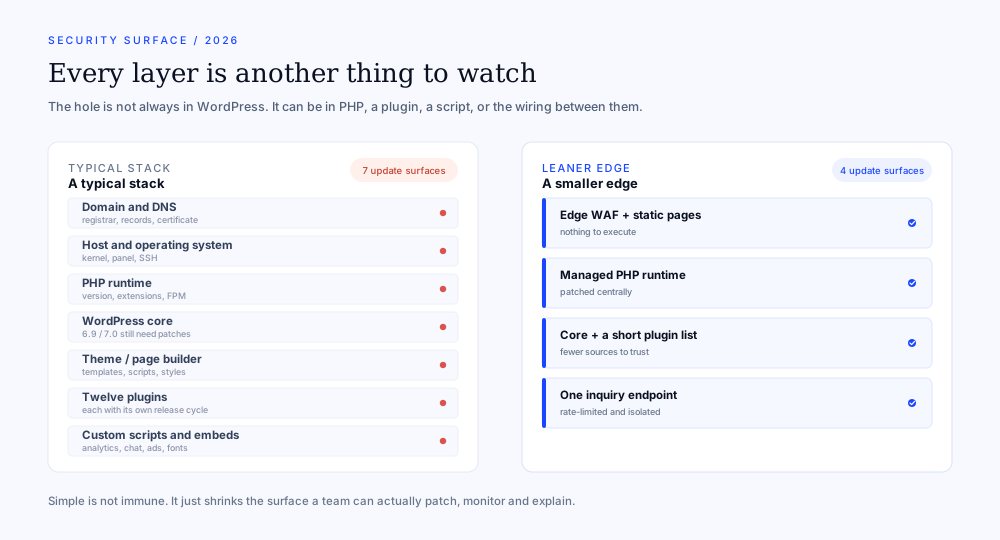
Simple does not mean fewer plugins and nothing else. It means clear boundaries: what is allowed to execute code, what is read-only, what must stop on failure, and what must keep accepting business when a dependency fails. A team that can explain the request path at three in the morning is better protected than a diagram full of security products.
WordPress is still a good choice. The risk is not the software itself. The risk is how easily it becomes a building with many doors, many tenants and no facilities manager.
AI can generate a website. It cannot generate a system.
Ask a model for a homepage today and you will get something usable in minutes. It may even look better than the site you paid for three years ago.
But a website is not a page. It is a system with a public front door.
AI-written code is often cleaner than ours because it carries no legacy. But clean code inside a complex system can still fail in the most complicated way.
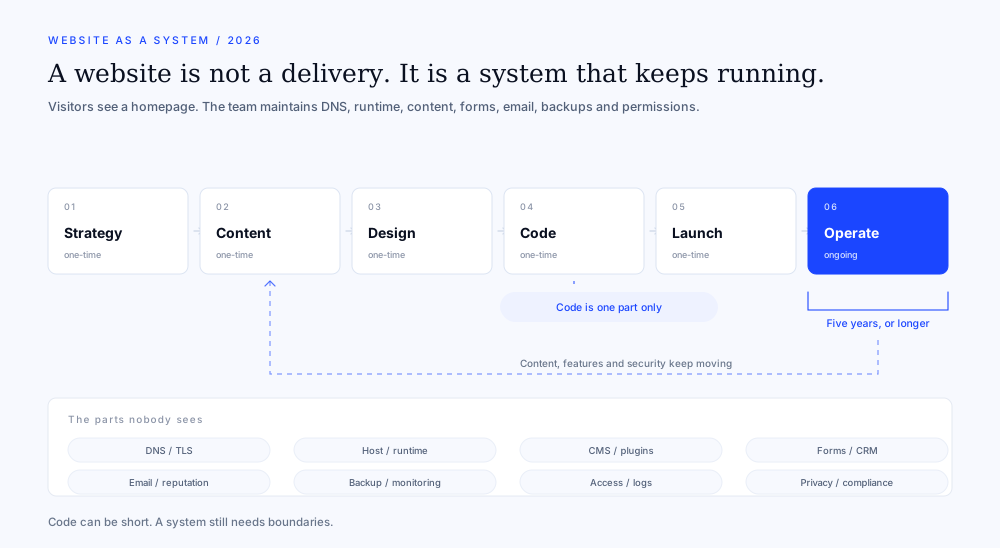
Before launch, you have the domain, DNS, certificates, hosting, runtime, CMS, plugins, forms, email, CRM, analytics, backups, permissions and privacy compliance. After launch, you have content, patching, performance, SEO, conversion, accessibility and incident response. Visitors see the homepage. The team maintains the chain.
AI can write each piece. It will not organize them into something that can be held accountable.
Correct code is not the same as a correct system. A form handler can be elegant and still fail the business: the notification lands in spam, the inquiry never reaches the CRM, the backup has never been restored. AI can draw an architecture diagram. It cannot carry the consequences of the drawing.
Architecture is a set of trade-offs: budget, team capability, risk tolerance, content ownership, legacy systems, regulatory requirements. AI can list the options. A person still has to choose, and that person has to know what each choice will look like in three years. This is why stronger AI makes the job more like systems engineering, not less.
The cost curve is moving.
Design and build is a one-time invoice. Operations is a subscription you never cancel. For years, many companies put most of the budget into the launch and treated maintenance as optional, until the site went down or the inquiry form had been quietly broken for two weeks.
My bet is that over the next five years, the center of gravity in a website budget shifts from "get it built" to "keep it usable, trustworthy and effective." Not because building got more expensive, but because it got cheaper. When generating a page approaches zero cost, the scarce things are judgment, organization and someone who stays accountable.
The five-year test for a website is not visual. It is operational: change the marketing lead, change the agency, change the CMS. Can the site still be handed over without a rewrite?
That is why, when we build a bespoke website, we ask questions that sound only loosely related to design: Who maintains this after launch? Who writes the content? Who owns the server? Who makes the call when it breaks? If those answers do not exist, the design is rented.
AI lowers the cost of making something. It raises the cost of running it well.
Put AI inside the guardrails
The value of AI on a website is not a chat bubble in the corner. It is the removal of repetitive judgment and repetitive work.
There are four places where we see it pay off.
Inquiry filtering. The easiest place to do damage with AI is an inquiry form. A false positive costs more than a hundred false negatives: you lose the buyer, and you never know it. So the model does not delete anything. It quarantines, ranks and explains. The original message stays. A person reviews. If the model is unavailable, the form still accepts the inquiry and marks it for review. The goal is to reduce noise for sales, not to let a model make the sales decision.
Less-common languages. This is not a matter of pasting Chinese into a translation API. Start with a glossary, product specifications, units, regulatory language and brand voice. Then translate. Then have a human review. Arabic needs right-to-left layout. German compounds break navigation. Russian cases change the meaning of a product name. Spanish and Portuguese are not one market. The first translation is the easy part. The hard part is the update three months later, when the product spec changes and every language has to follow.
A sales assistant. It should answer from the site's own content and cite the product page, FAQ or case study it used. When it cannot answer, it hands over to a person. It does not invent a price, a lead time or a certification. It has read-only access. It cannot edit pages or email a customer without approval.
Content operations. Drafting, summarizing, internal-link suggestions, metadata and stale-content audits are all fair game. Every change goes through staging, keeps a diff and can be rolled back. A person still checks the things a model cannot know: Is this our position? Is this number current? Is this client still willing to be named?
In all four, AI proposes. A person decides.
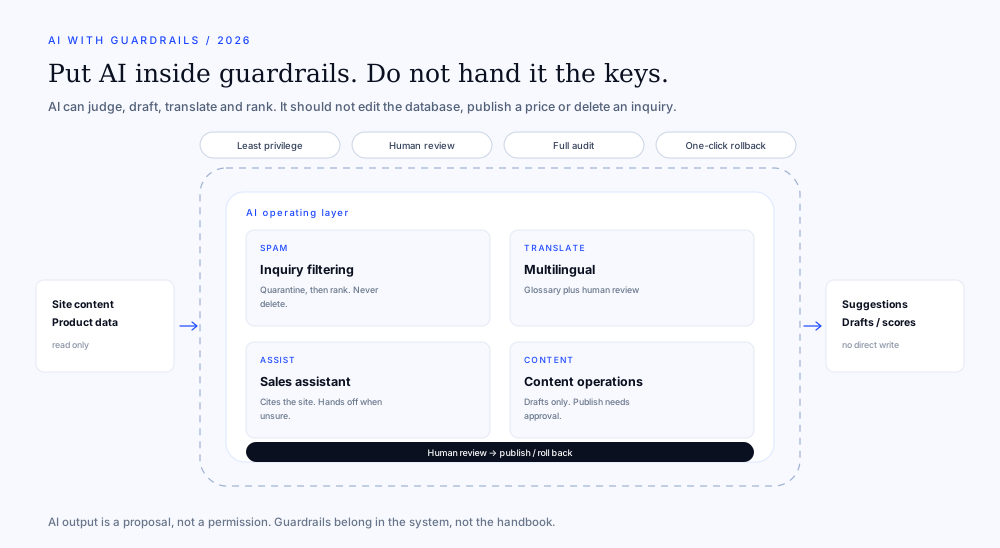
Guardrails have to be built into the system, not written into a handbook.
- Least privilege. Read-only by default. Writes go through controlled tools. No direct database or shell access.
- Human approval. Publishing content, changing a price, deleting an inquiry or emailing a customer requires a person to confirm.
- Full audit. Prompts, sources, outputs, approvers and diffs are logged.
- Rollback. Content is versioned. So are models and prompts. A bad output can be reversed.
- Fail open for business. If the model is down, the inquiry is still accepted and flagged. Do not lose a lead because a dependency failed.
- Evaluation. Keep a fixed test set and watch false positives and false negatives. Do not rely on a good demo.
A person can ignore a process. A person cannot ignore permissions and logs. That is the difference between a policy and a guardrail.
Over the next three to five years, this will move from a differentiator to a baseline. AI reception, terminology-level translation, inquiry filtering, content operations, audit and rollback will be as standard as HTTPS, a CDN and backups are today.
Not every company will train its own model. The realistic split is this: the company owns the content and the customer relationship; the service provider owns the model, the workflow, the permissions and the audit trail. The company does not need to know how fine-tuning works. It needs to know what the AI can do, what it cannot do, and who is accountable when it is wrong.
Five questions before you rebuild
- After launch, who owns updates, patches, backups and incident response?
- Which pages can be static, and which must be dynamic? Is the dynamic entry point isolated?
- Who owns the content, design, code and data? Can you take them with you?
- What is AI allowed to do, and what is it not? Who reviews it, and how do you roll it back?
- If you change technology or agencies in three years, can the site still be maintained?
Those questions matter more than whether AI can build you a website.
AI will keep lowering the cost of making a site. It will keep raising the cost of running one well. Longevity is not a slogan. It is a set of unglamorous choices: one less execution path, one more rollback record; one less forgotten plugin, one more tested restore; a little less "ship it and see," a little more "who owns this after launch."
Those choices are not exciting. They determine whether a website survives the next technology cycle.
If you are planning a new site, or want a security and operations review of the one you have, start a conversation. We will look at the architecture before we talk about the design.
References
- Searchlight Cyber: wp2shell, pre-authentication RCE in WordPress core
- WordPress security advisory GHSA-ff9f-jf42-662q
- Wiz: PHP2Shell, AI uncovers critical RCE vulnerabilities in PHP
- Wiz: PHP2Shell exploitation attempts and remediation trends
- PHP 2026 security releases
- CISA: two vulnerabilities added to the Known Exploited Vulnerabilities catalog

A Shanghai company delivering bespoke websites from Suzhou.